Changes in Our Climate: Meaning and Examples of Weather symbols, Meaning and Examples of Weather Records, Global Warming and Effects of Climate Change Primary 6 (Basic 6) Second Term Week 3 Basic Science and Technology
BASIC SCIENCE AND TECHNOLOGY
SECOND TERM
WEEK 3
PRIMARY 6 (BASIC 6)
THEME – LEARNING ABOUT OUR ENVIRONMENT
TOPIC – CHANGES IN OUR CLIMATE
LEARNING AREA
1. Introduction
2. Meaning and Examples of Weather Symbols
3. Meaning and Examples of Weather Records
4. Global Warming and Effects of Climate Change on the Earth
5. Weekly Assessment: Test Questions and Answers/Assignment
6. Summary
LEARNING OBJECTIVES
By the end of the lesson, pupils should be able to:
1. Define weather symbols.
2. Identify and interpret common weather symbols.
3. Explain the meaning of weather records.
4. State examples of weather records.
5. Explain the meaning of global warming.
6. State the effects of climate change.
7. Suggest ways of reducing climate change.
ENTRY BEHAVIOUR
Pupils have previously learned about air, the atmosphere, and different weather conditions such as sunshine, rainfall, wind, and clouds.
This lesson builds on that knowledge by introducing weather symbols used to represent weather conditions, weather records used to monitor and study weather over time, and the concepts of global warming and climate change and their effects on the environment.
INSTRUCTIONAL MATERIALS
The teacher will teach the lesson with the aid of:
1. Charts of common weather symbols
2. Weather map
3. Flash cards
4. Pictures of different weather conditions
5. Weather instruments (thermometer, rain gauge, wind vane, anemometer)
6. Textbooks
METHOD OF TEACHING
Choose a suitable and appropriate methods for the lessons.
Note – Irrespective of choosing methods of teaching, always introduce an activities that will arouse pupil’s interest or lead them to the lessons.
REFERENCE MATERIALS
1. Scheme of Work
2. 9 – Years Basic Education Curriculum
3. Course Book
4. All Relevant Material
5. Online Information
CONTENT OF THE LESSON
INTRODUCTION
Weather information is very important in our daily life. It helps farmers know when to plant crops, helps pilots and sailors to travel safely, and helps people plan their daily activities.
To make weather information easy to understand, scientists use weather symbols to represent different weather conditions such as sunshine, rain, clouds, and wind.
Weather conditions are also carefully measured and recorded over time as weather records. These records help scientists to study changes in weather and climate.
However, due to human activities such as pollution and deforestation, the Earth is getting warmer. This is called global warming, and it leads to climate change, which affects people, animals, plants, and the environment.
In this lesson, pupils will learn about weather symbols, weather records, global warming, and the effects of climate change.
LESSON 1 – MEANING OF WEATHER SYMBOLS
Weather symbols are simple drawings or signs used on weather charts and maps to represent different weather conditions. They are used to make weather information easy to read and understand quickly.
EXAMPLES OF WEATHER SYMBOLS
- ☀️ Sunny weather symbol – represents bright sunshine.
- ☁️ Cloudy weather symbol – represents clouds covering the sky.
- 🌧️ Rainy weather symbol – represents rainfall.
- ⛈️ Thunderstorm symbol – represents rain with thunder and lightning.
- 🌬️ Windy weather symbol – represents strong wind.
- 🌫️ Foggy weather symbol – represents low visibility due to fog.
- ❄️ Snowy weather symbol – represents snow (in cold regions).
IMPORTANCE OF WEATHER SYMBOLS
1. They make weather reports easy to understand.
2. They help people quickly know the weather condition.
3. They are used in newspapers, TV, and weather forecasts.
4. They help farmers, pilots, and sailors plan activities.
5. They save time in explaining weather conditions.
LESSON 2 – MEANING OF WEATHER RECORDS
Weather records are the information collected and written down about weather conditions over a period of time. These records help scientists study weather patterns, make weather forecasts, and understand climate changes.
Weather records are collected using special weather instruments.
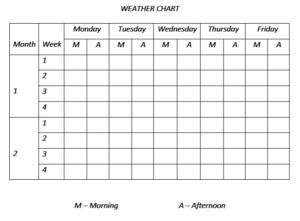
EXAMPLES OF WEATHER RECORDS
1. Temperature Record – shows how hot or cold the weather is.
- Instrument: Thermometer
2. Rainfall Record – shows the amount of rain that falls.
- Instrument: Rain Gauge
3. Wind Speed Record – shows how fast the wind is blowing.
- Instrument: Anemometer
4. Wind Direction Record – shows the direction from which the wind is blowing.
- Instrument: Wind Vane
5. Air Pressure Record – shows the pressure of the air.
- Instrument: Barometer
6. Humidity Record – shows the amount of water vapour in the air.
- Instrument: Hygrometer
7. Sunshine Record – shows the amount of sunshine received in a day.
- Instrument: Sunshine Recorder
IMPORTANCE OF WEATHER RECORDS
1. They help scientists predict and forecast the weather.
2. They help farmers know the best time for planting and harvesting.
3. They help pilots, sailors, and drivers plan safe journeys.
4. They help people prepare for storms, floods, and droughts.
5. They help scientists study climate change and global warming.
6. They assist governments in planning for disasters and protecting lives and property.
LESSON 3 – MEANING OF CLIMATE CHANGE
Climate change is the long-term change in the Earth’s weather patterns. It includes changes in temperature, rainfall, wind, and seasons, largely caused by global warming.
MEANING OF GLOBAL WARMING
Global warming is the gradual increase in the Earth’s average temperature caused mainly by human activities such as burning fossil fuels, deforestation, and pollution. These activities release greenhouse gases that trap heat in the atmosphere.
CAUSES OF GLOBAL WARMING AND CLIMATE CHANGE
1. Cutting down trees (deforestation).
2. Burning of fossil fuels such as petrol, diesel, coal, and gas.
3. Bush burning.
4. Smoke from factories and vehicles.
5. Air pollution caused by human activities.
EFFECTS OF GLOBAL WARMING AND CLIMATE CHANGE ON THE ENVIRONMENT
Global warming and climate change have many harmful effects on the environment. Some of these effects include:
1. Higher temperatures – The Earth becomes hotter than normal, leading to extreme heat.
2. Irregular rainfall – Rain may fall too much in some places and too little in others, affecting farming and water supply.
3. Flooding – Heavy rainfall can cause rivers to overflow, destroying homes, roads, and farmlands.
4. Drought – Long periods without rain can dry up rivers, lakes, and farmland, leading to water shortages.
5. Desertification – Fertile land gradually becomes dry and barren, making it difficult to grow crops.
6. Melting of glaciers and polar ice – Rising temperatures cause ice in cold regions to melt.
7. Rising sea levels – Melting ice increases the volume of seawater, causing coastal flooding.
8. Loss of plants and animals – Some plants and animals lose their natural habitats and may become endangered or extinct.
9. Poor agricultural production – Changes in weather reduce crop yields and may lead to food shortages.
10. More natural disasters – There is an increase in storms, heat waves, wildfires, and other extreme weather events.
11. Damage to ecosystems – Forests, wetlands, rivers, and other natural environments are affected, disrupting the balance of nature.
12. Health problems – Increased heat and pollution can lead to illnesses such as heat stress and respiratory diseases.
WAYS TO REDUCE GLOBAL WARMING AND CLIMATE CHANGE
1. Plant more trees.
2. Do not cut down trees unnecessarily.
3. Avoid bush burning.
4. Keep the environment clean.
5. Reduce pollution.
6. Save electricity and fuel.
7. Create awareness about protecting the environment.
WEEKLY ASSESSMENT: TEST QUESTIONS AND ANSWERS/ASSIGNMENT
A. Objective Questions (Choose the Correct Answer)
1. Weather symbols are used to show ______.
A. weather conditions
B. food
C. houses
D. roads
2. Which weather symbol represents rainfall?
A. Sun
B. Cloud with rain
C. Wind
D. Star
3. Weather records are information collected about ______.
A. animals
B. schools
C. weather conditions
D. markets
4. Which instrument is used to measure rainfall?
A. Thermometer
B. Rain gauge
C. Hygrometer
D. Rain gauge
5. Global warming is the ______ in the Earth’s temperature.
A. decrease
B. increase
C. colour
D. size
B. Fill in the Blanks
6. A symbol of the ______ represents sunny weather.
7. A ______ is used to measure temperature.
8. Weather records help scientists predict the ______.
9. ______ is the long-term change in weather patterns.
10. Planting more ______ helps reduce global warming.
C. True or False
11. Weather symbols make weather reports easier to understand. ______
12. A rain gauge measures rainfall. ______
13. Global warming makes the Earth colder. ______
14. Flooding is one effect of climate change. ______
15. Keeping the environment clean helps protect the Earth. ______
D. Short Answer Questions
16. What are weather symbols?
17. Mention four examples of weather records.
18. What is global warming?
19. State four effects of global warming and climate change on the environment.
20. Mention four ways to reduce global warming and climate change.
ANSWER GUIDE
1. A
2. B
3. C
4. D
5. B
6. Sun
7. Thermometer
8. Weather
9. Climate change
10. Trees
11. True
12. True
13. False
14. True
15. True
16. Weather symbols are simple signs used to represent different weather conditions.
17. Temperature, rainfall, wind speed, wind direction, air pressure, humidity, sunshine (any four).
18. Global warming is the gradual increase in the Earth’s temperature.
19. Any four: Hotter weather, floods, drought, poor crop growth, melting ice, rising sea levels, loss of plants and animals.
20. Any four: Plant more trees, avoid cutting down trees, reduce pollution, avoid bush burning, recycle waste, save electricity and fuel, keep the environment clean.
SUMMARY
In this lesson, pupils learned that weather symbols are simple signs used to represent different weather conditions such as sunshine, rain, clouds, wind, and thunderstorms.
They also learned that weather records are information collected about weather conditions over time. Examples of weather records include temperature, rainfall, wind speed, wind direction, air pressure, humidity, and sunshine.
Furthermore, pupils learned that global warming is the gradual increase in the Earth’s temperature, while climate change is the long-term change in weather patterns caused mainly by global warming.
Finally, pupils discussed the effects of global warming and climate change on the environment, such as hotter weather, floods, drought, poor crop growth, melting ice, rising sea levels, and the loss of plants and animals. They also learned that planting trees, reducing pollution, avoiding bush burning, and keeping the environment clean can help protect the Earth.
PRESENTATION
To deliver the lesson, the teacher adopts the following steps:
1. The teacher displays charts showing different weather symbols and weather instruments.
Pupils’ Activities: Pupils observe the charts and identify the weather symbols and instruments.
2. The teacher explains the meaning of weather symbols.
Pupils’ Activities: Pupils define weather symbols and mention examples.
3. The teacher explains the meaning of weather records and introduces common weather instruments.
Pupils’ Activities: Pupils identify weather records such as temperature, rainfall, wind speed, and air pressure.
4. The teacher explains how weather records help people predict the weather and plan activities.
Pupils’ Activities: Pupils discuss the importance of weather records in farming, transportation, and daily life.
5. The teacher explains the meaning of global warming and climate change.
Pupils’ Activities: Pupils explain global warming and climate change in their own words.
6. The teacher discusses the causes and effects of global warming and climate change using pictures and real-life examples.
Pupils’ Activities: Pupils identify the effects of climate change on people and the environment.
7. The teacher explains simple ways to reduce global warming and protect the environment.
Pupils’ Activities: Pupils mention ways they can help protect the environment, such as planting trees and keeping their surroundings clean.
8. The teacher asks oral questions to assess pupils’ understanding.
Pupils’ Activities: Pupils answer the questions and participate actively.
9. The teacher summarizes the lesson.
Pupils’ Activities: Pupils participate in the summary and write important points in their notebooks.
10. The teacher gives classwork, marks pupils’ responses, and provides corrections where necessary.
Pupils’ Activities: Pupils complete the exercise and correct their mistakes.
CONCLUSION
To conclude the lesson for the week, the teacher revises the entire lesson and links it to the following week’s lesson.
NEXT LESSON
LESSON EVALUATION
Teacher asks pupils,
1. What are weather symbols?
2. Mention five examples of weather symbols.
3. What are weather records?
4. State five examples of weather records.
5. What is global warming?
6. Mention five effects of global warming and climate change on the environment.
7. State five ways to reduce global warming and protect the environment.
Objects for National Consciousness Basic 7 (JSS 1)

Meaning and Types of Class Assignments (Reasons for Giving Class Assignments)

The Earth and Its Movement: The Sun, Moon and Earth, Effects of the Interaction Between the Sun and the Earth, Rotation, Revolution, Solar and Lunar Eclipse, and Sources of Light for the Earth Primary 6 (Basic 6) Second Term Week 4 Basic Science And Technology
About The Author

Alabi M. S.
Michael is a Principal Education Officer at LASUBEB with over 15 years of experience in teaching and learning. He is passionate about developing plan lesson notes and promoting quality assurance in education. Michael strongly believes that teachers inspire the future and play a vital role in shaping the next generation.