Picture Story (Concept of Points) Primary 6 (Basic 6) Third Term Week 1 English Studies
PICTURE STORY (CONCEPT OF POINTS) PRIMARY 6 (BASIC 6) THIRD TERM WEEK 1 ENGLISH STUDIES
THIRD TERM
WEEK 1 (REVISION)
PRIMARY 6 (BASIC 6)
THEME –
PREVIOUS LESSON –
TOPIC – PICTURE STORY
LEARNING AREA
1. Introduction
LEARNING OBJECTIVES
By the end of the lesson, most pupils should have attained the following objectives –
1. identify the features/contents of the picture or graphics.
2. locate the information from the pictures/graphics.
3. write the information in well organised paragraphs.
ENTRY BEHAVIOUR
The pupils can identify and explain the content of a picture
INSTRUCTIONAL MATERIALS
The teacher will teach the lesson with the aid of:
1. Different picture stories.
2. Pictures across all subjects.
METHOD OF TEACHING
Choose a suitable and appropriate methods for the lessons.
Note – Irrespective of choosing methods of teaching, always introduce an activities that will arouse pupil’s interest or lead them to the lessons.
REFERENCE MATERIALS
1. Scheme of Work
2. 9 – Years Basic Education Curriculum
3. Course Book
4. All Relevant Material
5. Online Information
CONTENT OF THE LESSON
LESSON INTRODUCTION
A picture story is a story told using a series of pictures arranged in order. Each picture shows an event, and together they form a complete story. The concept of points helps pupils identify and explain the main ideas in each picture.
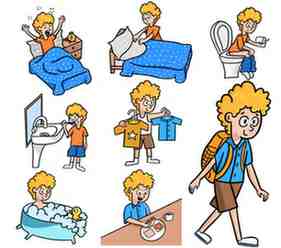
MEANING OF POINTS IN A PICTURE STORY
Points are the main ideas or important details shown in each picture. Each point helps to build the story step by step.
FEATURES OF A PICTURE STORY
It contains a series of pictures arranged in order.
- Each picture shows an action or event.
- Each picture represents a point in the story.
- The story has a beginning, middle, and end.
HOW TO INTERPRET A PICTURE STORY
- Look at all the pictures carefully.
- Identify what is happening in each picture.
- Arrange the events in the correct order.
- Write or tell the story using clear sentences.
EXAMPLE OF PICTURE STORY POINTS
Example: A boy going to school.
- Point 1: The boy wakes up early in the morning.
- Point 2: He brushes his teeth and takes his bath.
- Point 3: He wears his school uniform.
- Point 4: He eats breakfast and goes to school.
CLASS ACTIVITIES
- Pupils look at a set of pictures provided by the teacher.
- Pupils identify the main points in each picture.
- Pupils arrange pictures in the correct order.
- Pupils tell or write the story based on the pictures.
- Pupils work in groups to discuss the story.
PRESENTATION
To introduce the lesson, the teacher revises the previous lesson. Based on this, he/she asks the pupils some questions.
1. The teacher organizes the pupils into groups or pairs depending on the size of the class.
Pupils’ Activities: Each pupil belongs to a group.
2. The teacher gives each group two or more picture stories for the pupils to study, identify, and translate the content into meaningful sentences.
Pupils’ Activities: The groups study the pictures, identify them, and translate the content into meaningful sentences.
3. The teacher uses the chart/flashcards and the pupils’ responses to introduce the lesson and explains the meaning and features of picture stories.
Pupils’ Activities: The pupils pay attention to the lesson introduction, understand, and explain the meaning and features of picture stories.
4. The teacher leads and guides the pupils on how to interpret a picture story.
Pupils’ Activities: The pupils follow the teacher’s guidance on how to interpret a picture story.
5. The teacher gives the groups more picture stories to examine and to form well-organized sentences.
Pupils’ Activities: The pupils confidently examine the pictures and form well-organized sentences.
6. The teacher summarizes the lesson on the board and gives appropriate evaluation.
Pupils’ Activities: The pupils participate actively in the summary of the lesson by responding correctly to most of the questions as instructed.
CONCLUSION
To conclude the lesson for the week, the teacher revises the entire lesson and links it to the following week’s lesson.
NEXT LESSON
LESSON EVALUATION
Teacher asks pupils,
1. What is a picture story?
2. What are points in a picture story?
3. Arrange the following events in order (teacher provides pictures).
4. Mention two features of a picture story.
5. Write a short story from a given picture seque nce.

Season’s Greetings

Basic Motor Parts: Meaning and Types of Vehicles, External Parts, Advantages and Disadvantages of Vehicles Primary 4 (Basic 4) Third Term Week 4 Basic Science and Technology

Farm Animals Diseases – Modes of Transmission of Farm Animal Diseases | Effects of Diseases on the Farm Animals | Methods of Preventing and Control of Animal Diseases JSS 2 Agriculture
About The Author

Alabi M. S.
Michael is a Principal Education Officer at LASUBEB with over 15 years of experience in teaching and learning. He is passionate about developing plan lesson notes and promoting quality assurance in education. Michael strongly believes that teachers inspire the future and play a vital role in shaping the next generation.