Gymnastics: Meaning and Types of Gymnastic Activities (Basic Floor and Apparatus Activities) Primary 4 (Basic 4) Second Term Week 9 Physical and Health Education
GYMNASTICS: MEANING AND TYPES OF GYMNASTIC ACTIVITIES, BASIC FLOOR AND APPARATUS ACTIVITIES
PHYSICAL AND HEALTH EDUCATION (PHE)
PRIMARY 4 – SECOND TERM – WEEK 9
THEME – GAMES AND SPORTS (GYMNASTICS)
TOPIC – GYMNASTICS
LEARNING AREA
1. Introduction
2. Meaning and Types of Gymnastic Activities
3. Practical Demonstration of Gymnastic Activities
4. Weekly Assessment: Test Questions and Answers/Assignment
5. Summary
LEARNING OBJECTIVES
By the end of the lesson, pupils should be able to:
1. Define gymnastics.
2. Explain the meaning of gymnastic activities.
3. Identify the types of gymnastic activities.
4. Distinguish between basic floor activities and apparatus activities.
5. Demonstrate simple gymnastic activities safely.
ENTRY BEHAVIOUR
Pupils have previously learned about basketball and other physical activities that improve physical fitness, strength, balance, and coordination.
This lesson builds on that knowledge by introducing gymnastics, another form of physical activity. Pupils will learn the meaning of gymnastics, the types of gymnastic activities, and the basic floor and apparatus activities that help improve flexibility, balance, body control, and overall physical fitness.
INSTRUCTIONAL MATERIALS
The teacher will teach the lesson with the aid of:
1. Gymnasium mat or soft mat
2. Skipping rope
3. Balance beam (or wooden bench)
4. Gymnastic bench
5. Hoops
6. Pictures/charts of gymnastic activities
7. Whistle
METHOD OF TEACHING
Choose a suitable and appropriate methods for the lessons.
Note – Irrespective of choosing methods of teaching, always introduce an activities that will arouse pupil’s interest or lead them to the lessons.
REFERENCE MATERIALS
1. Scheme of Work
2. 9 – Years Basic Education Curriculum
3. Course Book
4. All Relevant Material
5. Online Information
CONTENT OF THE LESSON
INTRODUCTION
Have you ever seen people rolling, jumping, balancing, or stretching on a mat or using equipment such as a balance beam? These activities are called gymnastics. Gymnastics helps people develop strength, flexibility, balance, coordination, and body control.
In this lesson, pupils will learn the meaning of gymnastics, the types of gymnastic activities, and the basic floor and apparatus activities. They will also practise simple gymnastic movements safely to improve their physical fitness and confidence.
LESSON 1 – MEANING OF GYMNASTICS
Gymnastics is a physical activity that involves exercises such as stretching, balancing, jumping, rolling, climbing, swinging, and bending to improve strength, flexibility, balance, coordination, and body control.
TYPES OF GYMNASTIC ACTIVITIES
There are two main types of gymnastic activities: Basic Floor and Apparatus Activities
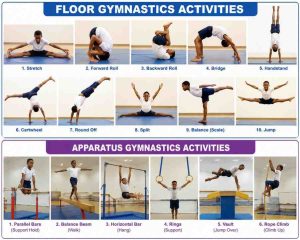
BASIC FLOOR ACTIVITIES
These are exercises performed on the floor or on a gymnastic mat without using large equipment.
Examples of Floor Activities include:
1. Forward Roll – A forward roll is rolling the body forward on a mat from the head and shoulders to the back and feet.
2. Backward Roll – A backward roll is rolling the body backward on a mat from a sitting or squatting position until standing up again.
3. Cartwheel – A cartwheel is turning the body sideways by placing the hands on the ground and swinging the legs over the head, one after the other.
4. Handstand – A handstand is balancing the body upside down with both hands on the ground and the feet pointing upward.
5. Headstand – A headstand is balancing the body upside down with the head and hands supporting the body while the legs are raised upward.
6. Jumping – Jumping is pushing the body off the ground with one or both feet and landing safely.
7. Balancing – Balancing is keeping the body steady without falling while standing or moving.
8. Stretching – Stretching is gently moving the arms, legs, and body to make the muscles flexible and ready for exercise.
PRACTICAL DEMONSTRATION OF BASIC FLOOR ACTIVITIES
The teacher demonstrates each activity before allowing pupils to practise.
1. Forward Roll
- Squat on the mat.
- Tuck the head in.
- Roll forward gently.
- Stand up carefully.
2. Backward Roll
- Sit on the mat.
- Roll backward carefully.
- Push with the hands.
- Return to a standing position.
3. Balance
- Stand on one foot.
- Stretch the arms sideways.
- Maintain balance for a few seconds.
4. Stretching
- Stretch the arms, legs, and body gently.
- Avoid sudden movements.
5. Jumping
- Jump with both feet together.
- Land softly with bent knees.
LESSON 2 – BASIC APPARATUS ACTIVITIES
These are exercises performed using special gymnastic equipment called apparatus.
Examples of Apparatus Activities include:
1. Balance Beam Activities – Balance beam activities are exercises performed while walking, balancing, or turning on a narrow beam to improve balance and body control.
2. Vaulting Activities – Vaulting activities are exercises in which a gymnast runs, jumps over a vaulting box or horse, and lands safely on the ground.
3. Horizontal Bar Activities – Horizontal bar activities are exercises performed by hanging, swinging, or turning on a strong horizontal bar.
4. Parallel Bar Activities – Parallel bar activities are exercises performed by supporting the body, swinging, and balancing on two parallel bars.
5. Rings Activities – Rings activities are exercises performed while hanging, swinging, and balancing on two suspended rings.
6. Pommel Horse Activities – Pommel horse activities are exercises performed by supporting the body with the hands and swinging the legs in circular movements over a padded apparatus called the pommel horse.
PRACTICAL DEMONSTRATION OF BASIC APPARATUS ACTIVITIES
1. Walking on a Balance Beam
- Walk slowly across the beam.
- Keep the arms stretched for balance.
- Look straight ahead.
2. Skipping with a Rope
- Hold the rope firmly.
- Swing the rope over the head.
- Jump over it with both feet.
3. Hoop Activities
- Roll the hoop.
- Jump in and out of the hoop.
- Spin the hoop safely.
4. Bench Activities
- Walk along the bench carefully.
- Step down safely without jumping.
GROUP PRACTICAL ACTIVITIES
The teacher divides pupils into groups and assigns each group to:
1. Demonstrate a forward roll.
2. Demonstrate balancing on one foot.
3. Walk across the balance beam.
4. Skip using a rope.
5. Perform hoop activities.
6. Stretch different parts of the body correctly.
7. Observe all safety rules while performing the activities.
The teacher supervises the pupils, corrects mistakes, encourages teamwork, and ensures that all activities are carried out safely.
LESSON 3 – IMPORTANCE OF GYMNASTICS
1. It improves flexibility.
2. It develops balance and coordination.
3. It strengthens muscles and bones.
4. It improves body control.
5. It builds confidence.
6. It promotes good posture.
7. It keeps the body healthy and fit.
8. It encourages discipline and concentration.
SAFETY RULES DURING GYMNASTICS
1. Always warm up before performing gymnastics activities.
2. Wear appropriate sportswear and shoes.
3. Use gymnastic equipment correctly.
4. Perform activities only under the teacher’s supervision.
5. Wait for your turn and do not push others.
6. Use a gymnastic mat for rolling and landing activities.
7. Check that the equipment is safe before use.
8. Keep the activity area clean and free from obstacles.
9. Perform movements carefully to avoid injuries.
10. Stop immediately and report to the teacher if you feel pain or get injured.
WEEKLY ASSESSMENT: TEST QUESTIONS AND ANSWERS/ASSIGNMENT
A. Multiple Choice Questions
1. Gymnastics is an activity that improves ______.
A. Reading
B. Strength and balance
C. Singing
D. Cooking
2. Which of the following is a basic floor activity?
A. Forward roll
B. Skipping with a rope
C. Walking on a balance beam
D. Climbing a ladder
3. Which of the following is a gymnastic apparatus?
A. Football
B. Whistle
C. Balance beam
D. Jersey
4. Which activity is performed using a rope?
A. Skipping
B. Forward roll
C. Stretching
D. Balancing
5. Before performing gymnastics activities, pupils should always ______.
A. Push one another
B. Run away
C. Remove the mat
D. Warm up
B. Fill in the Blanks
6. Gymnastics helps improve ______ and flexibility.
7. ______ and apparatus activities are the two main types of gymnastics.
8. A ______ is used to protect the body during floor activities.
9. A ______ beam is used for balancing.
10. Pupils should follow ______ rules during gymnastics activities.
C. True or False
11. Forward roll is a basic floor activity. ______
12. A hoop is a gymnastic apparatus. ______
13. Pupils should use gymnastics equipment carelessly. ______
14. Stretching is a basic floor activity. ______
15. Gymnastics helps improve coordination and balance. ______
D. Match Column A with Column B
Column A – Column B
16. Forward roll – A. Used for balancing
17. Balance beam – B. Improves flexibility
18. Rope – C. Floor activity
19. Stretching – D. Used for skipping
20. Mat – E. Protects the body during activities
ANSWER KEYS
1. B – Strength and balance
2. A – Forward roll
3. C – Balance beam
4. A – Skipping
5. D – Warm up
6. Strength
7. Floor
8. Mat
9. Balance
10. Safety
11. True
12. True
13. False
14. True
15. True
16. C – Forward roll → Floor activity
17. A – Balance beam → Used for balancing
18. D – Rope → Used for skipping
19. B – Stretching → Improves flexibility
10. E – Mat → Protects the body during activities
SUMMARY
In this lesson, pupils learned that gymnastics is a physical activity that involves exercises and movements which improve strength, flexibility, balance, coordination, and body control.
They also learned the two main types of gymnastic activities, namely:
- Basic Floor Activities – such as forward roll, backward roll, balancing, stretching, and jumping.
- Basic Apparatus Activities – such as activities performed with a balance beam, rope, hoop, and bench.
Finally, pupils understood the importance of observing safety rules during gymnastics activities, such as warming up before exercise, using equipment correctly, following the teacher’s instructions, taking turns, and practising carefully to prevent injuries.
PRESENTATION
To deliver the lesson, the teacher adopts the following steps:
Step 1: Introduction – The teacher asks pupils if they have ever watched or participated in gymnastics and displays pictures or videos of gymnastic activities.
Pupils’ Activities: Pupils observe the pictures or videos and identify different gymnastics activities.
Step 2: Meaning of Gymnastics – The teacher explains the meaning of gymnastics and its importance in developing strength, flexibility, balance, and coordination.
Pupils’ Activities: Pupils explain the meaning of gymnastics in their own words.
Step 3: Types of Gymnastic Activities – The teacher explains the two main types of gymnastic activities:
- Basic Floor Activities
- Basic Apparatus Activities
Pupils’ Activities: Pupils identify and differentiate between floor and apparatus activities.
Step 4: Basic Floor Activities – The teacher explains and demonstrates examples of basic floor activities such as:
- Forward roll
- Backward roll
- Balancing
- Stretching
- Jumping
Pupils’ Activities: Pupils identify each floor activity and practise simple movements.
Step 5: Basic Apparatus Activities – The teacher displays or demonstrates the use of simple gymnastic apparatus such as:
- Balance beam
- Rope
- Hoop
- Bench
The teacher explains the activities performed with each apparatus.
Pupils’ Activities: Pupils identify the apparatus and describe the activities performed with them.
Step 6: Safety Rules – The teacher explains the safety rules to observe during gymnastics activities.
Pupils’ Activities: Pupils state the safety rules and explain why they are important.
Step 7: Lesson Summary – The teacher reviews the meaning of gymnastics, the two types of gymnastic activities, examples of floor and apparatus activities, and the safety rules.
Pupils’ Activities: Pupils summarize the lesson by answering questions and mentioning key points.
Step 8: Evaluation – The teacher asks oral and written questions, assesses pupils’ responses, and provides corrections where necessary.
Pupils’ Activities: Pupils answer the questions and participate actively in the lesson evaluation.
CONCLUSION
To conclude the lesson for the week, the teacher revises the entire lesson and links it to the following week’s lesson.
NEXT LESSON
LESSON EVALUATION
Teacher asks pupils,
1. Define gymnastics.
2. Mention the two main types of gymnastic activities.
3. List five examples of basic floor activities.
4. Mention five examples of gymnastic apparatus.
5. State four basic apparatus activities.
6. Mention five safety rules to observe during gymnastics activities.
7. State five benefits of participating in gymnastics.
8. Explain the difference between basic floor activities and basic apparatus activities.
Counting, Reading and Writing Whole Number 11 – 20 (Primary 1)

Primary 4 – First Term Examination for Agriculture Questions and Answers

Third Term Examination Yoruba Junior Secondary Schools – JSS 2 (Basic 8) Exam Questions
About The Author

Alabi M. S.
Michael is a Principal Education Officer at LASUBEB with over 15 years of experience in teaching and learning. He is passionate about developing plan lesson notes and promoting quality assurance in education. Michael strongly believes that teachers inspire the future and play a vital role in shaping the next generation.