Respiratory System: Meaning, Functions, Organs of the Respiratory System and Their Functions Primary 6 (Basic 6) First Term Week 11 Basic Science and Technology
BASIC SCIENCE AND TECHNOLOGY
FIRST TERM
WEEK 11
PRIMARY 6 (BASIC 6)
THEME – LIVING AND NON LIVING THINGS
TOPIC – RESPIRATORY SYSTEM
LEARNING AREA
1. Introduction
2. Meaning and Functions of Respiratory System
3. Organs That Make Up the Respiratory System and the Functions of Each Organ
4. Weekly Assessment: Test Questions and Answer/Assignment
5. Summary
LEARNING OBJECTIVES
By the end of the lesson, pupils should be able to:
1. Define the respiratory system.
2. State the functions of the respiratory system.
3. Identify the major organs of the respiratory system.
4. Explain the functions of each organ of the respiratory system.
5. Explain the importance of the respiratory system in maintaining life.
6. State ways of keeping the respiratory system healthy.
ENTRY BEHAVIOUR
Pupils have previously learned about the circulatory system, the human heart, and blood circulation. They know that blood carries oxygen and nutrients to all parts of the body.
This lesson builds on that knowledge by introducing the respiratory system, which supplies oxygen to the body through breathing and removes carbon dioxide. Pupils will also learn about the major organs of the respiratory system and the functions of each organ.
INSTRUCTIONAL MATERIALS
The teacher will teach the lesson with the aid of:
1. Chart of the human respiratory system
2. Diagram showing the lungs and air passages
3. Model of the respiratory system
4. Flash cards
5. Textbooks
METHOD OF TEACHING
Choose a suitable and appropriate methods for the lessons.
Note – Irrespective of choosing methods of teaching, always introduce an activities that will arouse pupil’s interest or lead them to the lessons.
REFERENCE MATERIALS
1. Scheme of Work
2. 9 – Years Basic Education Curriculum
3. Course Book
4. All Relevant Material
5. Online Information
CONTENT OF THE LESSON
INTRODUCTION
Every living person needs oxygen to stay alive. We obtain oxygen by breathing through a special body system known as the respiratory system. This system is made up of organs that work together to take in oxygen from the air and remove carbon dioxide from the body.
Without the respiratory system, the body cannot get the oxygen needed to produce energy and keep body organs functioning properly.
In this lesson, pupils will learn the meaning of the respiratory system, its functions, the organs that make up the respiratory system, and the functions of each organ.
LESSON 1 – MEANING OF THE RESPIRATORY SYSTEM
The respiratory system is the body system responsible for breathing. It takes in oxygen from the air and removes carbon dioxide from the body.
The respiratory system works together with the circulatory system to supply oxygen to all body cells and remove waste gases.
FUNCTIONS OF THE RESPIRATORY SYSTEM
1. It takes in oxygen from the air during breathing.
2. It removes carbon dioxide from the body during exhalation.
3. It supplies oxygen needed by body cells to produce energy.
4. It helps keep the body alive by supporting all body organs.
5. It filters dust, germs, and other harmful particles from the air before they reach the lungs.
6. It helps in speaking by allowing air to pass through the voice box.
7. It helps maintain a healthy balance of oxygen and carbon dioxide in the body.
LESSON 2 – IMPORTANCE OF THE RESPIRATORY SYSTEM
1. It provides oxygen needed for life.
2. It removes harmful waste gases from the body.
3. It supports the production of energy in body cells.
4. It works with the circulatory system to keep the body healthy.
5. It enables normal breathing and speaking.
CARING FOR THE RESPIRATORY SYSTEM
1. Avoid smoking and second-hand smoke.
2. Breathe clean, fresh air whenever possible.
3. Exercise regularly.
4. Keep the environment clean and free from dust.
5. Cover your nose and mouth when coughing or sneezing.
6. Seek medical attention when experiencing breathing difficulties.
LESSON 3 – ORGANS THAT MAKE UP THE RESPIRATORY SYSTEM AND THE FUNCTIONS OF EACH ORGAN
The respiratory system is made up of several organs that work together to help us breathe:
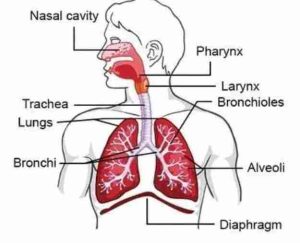
1. Nose (Nostrils)
Functions:
- It allows air to enter the body.
- It filters dust and germs from the air.
- It warms and moistens the air before it reaches the lungs.
2. Pharynx (Throat)
Functions:
- It serves as a passage for air from the nose to the larynx.
- It helps move air into the respiratory system.
3. Larynx (Voice Box)
Functions:
- It allows air to pass into the trachea.
- It produces sound for speaking.
- It protects the airway during swallowing.
4. Trachea (Windpipe)
Functions:
- It carries air from the larynx to the lungs.
- It helps filter dust and other particles before the air reaches the lungs.
5. Bronchi
Functions:
- They are tubes that carry air from the trachea into the right and left lungs.
- They distribute air throughout the lungs.
6. Lungs
Functions:
- The are the main organs of breathing.
- They absorb oxygen into the blood.
- They remove carbon dioxide from the blood.
7. Diaphragm
Functions:
- It is a sstrong muscle below the lungs.
- It helps the lungs expand during inhalation.
- It helps push air out of the lungs during exhalation.
WEEKLY ASSESSMENT: TEST QUESTIONS AND ANSWERS/ASSIGNMENT
A. Objective Questions (Choose the Correct Answer)
1. The respiratory system is responsible for ______.
A. digestion
B. breathing
C. circulation
D. movement
2. Which gas do we breathe in?
A. Carbon dioxide
B. Nitrogen
C. Oxygen
D. Hydrogen
3. The main organ of the respiratory system is the ______.
A. Lungs
B. Heart
C. Kidney
D. Liver
4. The windpipe is also called the ______.
A. Bronchus
B. Pharynx
C. Diaphragm
D. Trachea
5. Which muscle helps the lungs expand and contract during breathing?
A. Diaphragm
B. Biceps
C. Tongue
D. Stomach
B. Fill in the Blanks
6. The respiratory system removes ______ from the body.
7. Air enters the body through the ______.
8. The ______ connects the trachea to the lungs.
9. The ______ produces sound for speaking.
10. The lungs absorb ______ into the blood.
C. True or False
11. The lungs are the main organs of breathing. ______
12. The respiratory system removes oxygen from the body. ______
13. The diaphragm helps in breathing. ______
14. The nose filters dust from the air. ______
15. Smoking helps to keep the respiratory system healthy. ______
D. Short Answer Questions
16. What is the respiratory system?
17. Mention four organs of the respiratory system.
18. State three functions of the respiratory system.
19. What is the function of the lungs?
20. Mention three ways of keeping the respiratory system healthy.
ANSWER GUIDE
1. B
2. C
3. A
4. D
5. A
6. Carbon dioxide
7. Nose (or nostrils)
8. Bronchi
9. Larynx (voice box)
10. Oxygen
11. True
12. False
13. True
14. True
15. False
16. The respiratory system is the body system responsible for breathing. It takes in oxygen and removes carbon dioxide.
17. Nose, pharynx, larynx, trachea, bronchi, lungs, diaphragm (any four).
18. It takes in oxygen, removes carbon dioxide, helps body cells produce energy, filters air, and helps in speaking (any three).
19. The lungs absorb oxygen into the blood and remove carbon dioxide from the blood.
20. Breathe clean air, avoid smoking and second-hand smoke, exercise regularly, keep the environment clean, and seek medical care for breathing problems (any three).
SUMMARY
In this lesson, pupils learned that the respiratory system is the body system responsible for breathing. It takes in oxygen from the air and removes carbon dioxide from the body.
They also learned the functions of the respiratory system, which include supplying oxygen to the body, removing carbon dioxide, helping body cells produce energy, supporting life, filtering harmful particles from the air, and assisting in speaking.
Furthermore, pupils identified the major organs of the respiratory system, namely:
- Nose (Nostrils)
- Pharynx (Throat)
- Larynx (Voice Box)
- Trachea (Windpipe)
- Bronchi
- Lungs
- Diaphragm
They learned the functions of each organ and how they work together to make breathing possible.
Finally, pupils learned the importance of keeping the respiratory system healthy by breathing clean air, avoiding smoking and second-hand smoke, exercising regularly, maintaining good personal hygiene, and seeking medical attention when experiencing breathing difficulties.
PRESENTATION
To deliver the lesson, the teacher adopts the following steps:
1. The teacher displays a chart or model of the human respiratory system.
Pupils’ Activities: Pupils observe the chart and identify the organs shown.
2. The teacher explains the meaning of the respiratory system.
Pupils’ Activities: Pupils define the respiratory system in their own words.
3. The teacher discusses the functions of the respiratory system.
Pupils’ Activities: Pupils state the functions of the respiratory system.
4. The teacher identifies the major organs of the respiratory system on the chart.
Pupils’ Activities: Pupils identify and name the organs of the respiratory system.
5. The teacher explains the function of each organ of the respiratory system.
Pupils’ Activities: Pupils state the functions of the nose, pharynx, larynx, trachea, bronchi, lungs, and diaphragm.
6. The teacher demonstrates the process of breathing (inhalation and exhalation).
Pupils’ Activities: Pupils observe and practise breathing in and breathing out correctly.
7. The teacher discusses the importance of keeping the respiratory system healthy.
Pupils’ Activities: Pupils mention healthy habits that protect the respiratory system.
8. The teacher asks oral questions based on the lesson.
Pupils’ Activities: Pupils answer the questions and participate actively.
9. The teacher summarizes the lesson.
Pupils’ Activities: Pupils participate in the summary and take notes.
10. The teacher gives classwork and provides corrections where necessary.
Pupils’ Activities: Pupils complete the exercise and correct their mistakes.
CONCLUSION
To conclude the lesson for the week, the teacher revises the entire lesson and links it to the following week’s lesson.
NEXT LESSON
LESSON EVALUATION
Teacher asks pupils,
1. What is the respiratory system?
2. State five functions of the respiratory system.
3. Mention seven organs of the respiratory system and state one function of each.
4. Explain why the respiratory system is important to the human body.
5. State five ways of keeping the respiratory system healthy.

Identification of Different Types of Surface and Cleaning (Primary 5)

Meaning and Examples of Good Behaviour in Public Place Kindergarten (Age 5) Term 2 Week 2 Social Habits
Third Term Agriculture Plan Lesson Notes According to the the Lagos State Scheme of Work Primary 2 (Basic 2) Lesson Notes
About The Author

Alabi M. S.
Michael is a Principal Education Officer at LASUBEB with over 15 years of experience in teaching and learning. He is passionate about developing plan lesson notes and promoting quality assurance in education. Michael strongly believes that teachers inspire the future and play a vital role in shaping the next generation.