The Human Circulatory System (The Blood Circulation): Meaning and Functions of Blood Vessels, Blood Circulation, and Differences Between Arteries, Veins and Capillaries Primary 6 (Basic 6) First Term Week 5 Basic Science and Technology
BASIC SCIENCE AND TECHNOLOGY
FIRST TERM
WEEK 5
PRIMARY 6 (BASIC 6)
THEME – LIVING AND NON LIVING THINGS
TOPIC – THE HUMAN CIRCULATORY SYSTEM (BLOOD CIRCULATORY)
LEARNING AREA
1. Introduction
2. Meaning and Functions of Blood Vessels
3. Differences Between Arteries, Veins and Capillaries
4. Blood Circulation and How Blood Circulate in the Body
5. Weekly Assessment: Test Questions and Answers
6. Summary
LEARNING OBJECTIVES
By the end of the lesson, pupils should be able to:
1. Define blood vessels.
2. State the functions of blood vessels.
3. Explain blood circulation.
4. Identify the three main types of blood vessels.
5. Differentiate between arteries, veins, and capillaries.
6. Explain the importance of blood circulation in the human body.
ENTRY BEHAVIOUR
Pupils have previously learned about the circulatory system, the human heart, its structure, and its functions. They know that the heart pumps blood continuously throughout the body.
This lesson builds on that knowledge by teaching pupils how blood travels through blood vessels, the process of blood circulation, and the differences between arteries, veins, and capillaries, which work together to transport blood to and from all parts of the body.
INSTRUCTIONAL MATERIALS
The teacher will teach the lesson with the aid of:
1. Chart of the human circulatory system
2. Diagram showing arteries, veins, and capillaries
3. Model of the human heart and blood vessels
4. Flash cards
METHOD OF TEACHING
Choose a suitable and appropriate methods for the lessons.
Note – Irrespective of choosing methods of teaching, always introduce an activities that will arouse pupil’s interest or lead them to the lessons.
REFERENCE MATERIALS
1. Scheme of Work
2. 9 – Years Basic Education Curriculum
3. Course Book
4. All Relevant Material
5. Online Information
CONTENT OF THE LESSON
INTRODUCTION
The heart pumps blood continuously, but blood cannot reach every part of the body without special pathways called blood vessels. These vessels carry blood from the heart to all body parts and return it back to the heart.
There are three main types of blood vessels: arteries, veins, and capillaries. Each has a special function that helps blood circulate throughout the body.
In this lesson, pupils will learn the meaning and functions of blood vessels, how blood circulates in the body, and the differences between arteries, veins, and capillaries.
LESSON 1 – MEANING OF BLOOD VESSELS
Blood vessels are hollow tube-like structures that carry blood to and from the heart throughout the body.
They form a network that connects the heart to every part of the body.
TYPES OF BLOOD VESSELS
The three main types of blood vessels are: Arteries, Veins and Capillaries
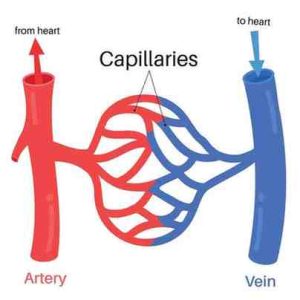
1. Arteries carry blood away from the heart.
2. Veins carry blood back to the heart.
3. Capillaries connect arteries and veins and allow the exchange of oxygen, nutrients, and waste products between the blood and body cells.
LESSON 2 – DIFFERENCES BETWEEN ARTERIES, VEINS AND CAPILLARIES
The three main types of blood vessels are arteries, veins, and capillaries. Each performs a different function in the circulatory system.
1. Arteries
- They carry blood away from the heart.
- They usually carry oxygen-rich blood.
- They have thick, strong, and elastic walls.
- They carry blood under high pressure.
- They have no valves inside them.
2. Veins
- They carry blood back to the heart.
- They usually carry oxygen-poor blood.
- They have thinner walls than arteries.
- They carry blood under low pressure.
- They have valves that prevent blood from flowing backwards.
3. Capillaries
- They are the smallest and thinnest blood vessels in the body.
- They connect arteries and veins.
- Their walls are very thin, allowing substances to pass through easily.
- They carry blood to body tissues and cells.
- They allow the exchange of oxygen, nutrients, carbon dioxide, and waste products between the blood and body cells.
Together, these three types of blood vessels ensure that blood circulates efficiently throughout the body.
FUNCTIONS OF BLOOD VESSELS
1. They carry blood from the heart to all parts of the body.
2. They return blood from the body back to the heart.
3. They transport oxygen and nutrients to body cells.
4. They carry carbon dioxide and other waste products away from body cells.
5. They help transport hormones to different parts of the body.
6. They maintain continuous blood circulation throughout the body.
7. They help keep body tissues alive by supplying them with oxygen and nutrients.
LESSON 3 – MEANING OF BLOOD CIRCULATION
Blood circulation is the continuous movement of blood from the heart to all parts of the body and back to the heart through the blood vessels.
This movement ensures that every part of the body receives oxygen and nutrients while waste products are carried away.
HOW BLOOD CIRCULATES IN THE BODY
1. The heart pumps oxygen-rich blood through the arteries to all parts of the body.
2. Body cells receive oxygen and nutrients from the blood.
3. The blood collects carbon dioxide and other waste products from the body cells.
4. The blood returns to the heart through the veins.
5. The heart pumps the blood to the lungs, where carbon dioxide is removed and oxygen is absorbed.
6. The oxygen-rich blood returns to the heart and is pumped around the body again.
WEEKLY ASSESSMENT: TEST QUESTIONS AND ANSWERS/ASSIGNMENT
A. Objective Questions (Choose the Correct Answer)
1. Blood vessels are ______ that carry blood throughout the body.
A. Bones
B. Muscles
C. Nerves
D. Hollow tubes
2. Which blood vessel carries blood away from the heart?
A. Vein
B. Capillary
C. Artery
D. Nerve
3. The smallest blood vessels in the body are called ______.
A. Arteries
B. Veins
C. Muscles
D. Capillaries
4. Blood circulation is the ______ of blood throughout the body.
A. Continuous movement
B. Colour
C. Shape
D. Size
5. Which blood vessels contain valves?
A. Arteries
B. Veins
C. Capillaries
D. All blood vessels
B. Fill in the Blanks
6. Blood vessels transport ______ throughout the body.
7. ______ carry blood back to the heart.
8..______ connect arteries and veins.
9. Blood circulation supplies ______ and nutrients to body cells.
10. The three main blood vessels are arteries, veins, and ______.
C. True or False
11. Arteries carry blood away from the heart. ______
12. Veins carry blood back to the heart. ______
13. Capillaries are the largest blood vessels. ______
14. Blood circulation helps remove waste products from the body. ______
15. Veins have valves that prevent the backward flow of blood. ______
D. Short Answer Questions
16. What are blood vessels?
17. Name the three main types of blood vessels.
18. What is blood circulation?
19. State two functions of blood vessels.
20. Mention two differences between arteries and veins.
ANSWER GUIDE
1. D
2. C
3. D
4. A
5. B
6. Blood
7. Veins
8. Capillaries
9. Oxygen
10. Capillaries
11. True
12. True
13. False
14. True
15. True
16. Blood vessels are hollow tube-like structures that carry blood to and from the heart throughout the body.
17. Arteries, veins, and capillaries.
18. Blood circulation is the continuous movement of blood from the heart to all parts of the body and back to the heart.
19. They transport blood throughout the body and carry oxygen, nutrients, hormones, and waste products (any two).
20. Arteries carry blood away from the heart, while veins carry blood back to the heart. Arteries have thick walls, while veins have thinner walls and contain valves.
SUMMARY
In this lesson, pupils learned that blood vessels are hollow tube-like structures that transport blood throughout the body. The three main types of blood vessels are arteries, veins, and capillaries.
They also learned that blood vessels carry oxygen, nutrients, hormones, and other useful substances to body cells while removing carbon dioxide and waste products. Blood vessels work together with the heart to maintain continuous blood circulation.
Pupils learned that blood circulation is the continuous movement of blood from the heart to all parts of the body and back to the heart. Blood circulation supplies oxygen and nutrients to body cells, removes waste products, transports hormones, helps fight infections, and keeps the body healthy.
Finally, pupils differentiated between the three types of blood vessels:
- Arteries carry blood away from the heart and have thick, strong walls.
- Veins carry blood back to the heart and contain valves that prevent the backward flow of blood.
- Capillaries are the smallest blood vessels and allow the exchange of oxygen, nutrients, carbon dioxide, and waste products between the blood and body cells.
Together, the heart, blood, and blood vessels work as one system to ensure proper blood circulation and keep the body functioning effectively.
PRESENTATION
To deliver the lesson, the teacher adopts the following steps:
1. The teacher displays a chart showing the human circulatory system and the different blood vessels.
Pupils’ Activities: Pupils observe the chart and identify the blood vessels.
2. The teacher explains the meaning of blood vessels.
Pupils’ Activities: Pupils define blood vessels in their own words.
3. The teacher identifies the three main types of blood vessels and explains their functions.
Pupils’ Activities: Pupils mention the three types of blood vessels and state their functions.
4. The teacher explains the process of blood circulation.
Pupils’ Activities: Pupils describe how blood moves from the heart to the body and back to the heart.
5. The teacher discusses the importance of blood circulation.
Pupils’ Activities: Pupils state the importance of blood circulation in the body.
6. The teacher explains the differences between arteries, veins, and capillaries.
Pupils’ Activities: Pupils compare the three types of blood vessels.
7. The teacher uses diagrams or illustrations to show the direction of blood flow in arteries, veins, and capillaries.
Pupils’ Activities: Pupils identify the direction of blood flow in each blood vessel.
8. The teacher asks oral questions based on the lesson.
Pupils’ Activities: Pupils answer the questions and participate actively.
9. The teacher summarizes the lesson.
Pupils’ Activities: Pupils participate in the summary and take notes.
10. The teacher gives classwork and provides corrections where necessary.
Pupils’ Activities: Pupils complete the exercise and correct their mistakes.
CONCLUSION
To conclude the lesson for the week, the teacher revises the entire lesson and links it to the following week’s lesson.
NEXT LESSON
LESSON EVALUATION
Teacher asks pupils,
1. What are blood vessels?
2. Mention the three main types of blood vessels and state one function of each.
3. Explain the meaning of blood circulation.
4. State five importance of blood circulation in the human body.
5. Differentiate between arteries, veins, and capillaries using five points.

Third Term Examination Verbal Reasoning Primary 1 (Basic 1) – Exam Questions

Meaning of Food Nutrients | Sources of Food Nutrients Primary 4 (Basic 4) – Home Economics

Land and Noise Pollution: Meaning, Sources, Effects and Control of Land and Noise Pollution Primary 5 (Basic 5) First Term Week 5 Basic Science and Technology
About The Author

Alabi M. S.
Michael is a Principal Education Officer at LASUBEB with over 15 years of experience in teaching and learning. He is passionate about developing plan lesson notes and promoting quality assurance in education. Michael strongly believes that teachers inspire the future and play a vital role in shaping the next generation.